The pop report isn't lying to you. It's answering a different question.
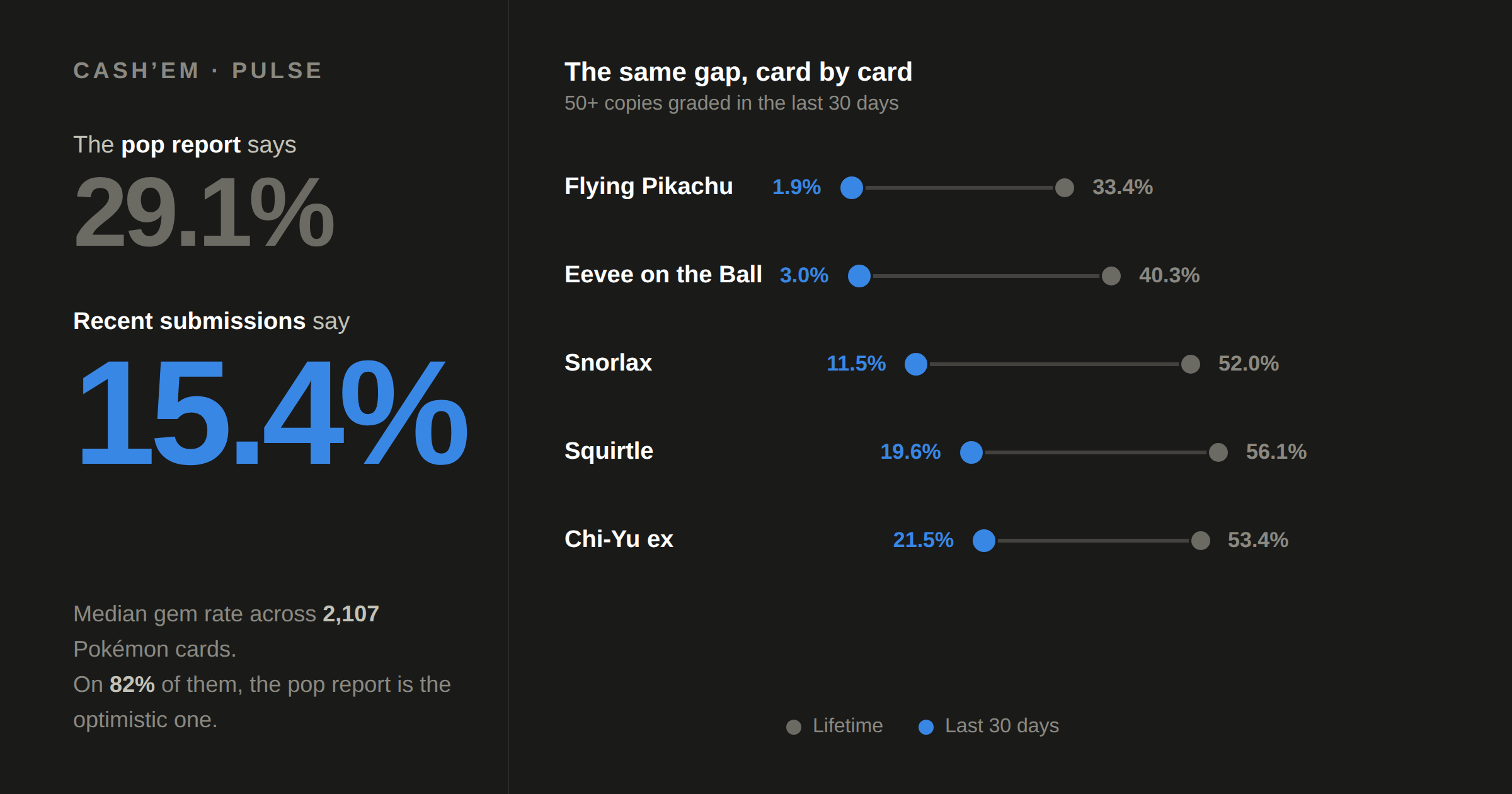
We measured both the lifetime gem rate and the marginal rate — last 30 days of submissions only. On 82% of cards, the pop report is the optimistic number. Post this →
2026-08-31
These figures are a live measurement, taken on the date above. They move as new submissions land — we re-ran this twice in one afternoon and the eligible pool grew by 38 cards. The medians did not move. The method is the durable part.
Before anyone sends a card to PSA, they check the pop report. Total graded, how many came back 10, do the division. On a card with 9,195 graded and 33% tens, the math looks like a third of submissions hit the top grade.
That number is real. It is also not the number you want.
The pop report gives you a lifetime rate — every copy ever graded, going back to whenever grading of that card began. You are not asking about every copy ever graded. You are asking about the one in your hand, going in this month, under this year's graders, against this year's standards.
So we measured both.
The gap
Every Pokémon card we hold population history for, with at least twenty copies newly graded in the last thirty days — 2,107 cards:
| median | |
|---|---|
| Lifetime gem rate — what the pop report shows | 29.1% |
| Marginal gem rate — last 30 days of submissions | 15.4% |
The rate on recent submissions is running at a little over half the rate printed on the pop report.
It is not a handful of outliers dragging an average. 1,731 of the 2,107 cards — 82% — moved the same direction. Where the two numbers disagree, they almost always disagree the same way, and the pop report is always the optimistic one.
It gets worse on the cards you'd actually send in
Narrow to cards where grading is even economically plausible — where the PSA 10 sells for more than $80 above the raw, enough to cover a grading fee — and the gap widens:
| all cards (n=2,107) | PSA 10 premium > $80 (n=1,690) | |
|---|---|---|
| Lifetime | 29.1% | 24.7% |
| Marginal | 15.4% | 10.0% |
| Marginal as % of lifetime | 53% | 40% |
Be careful with that second column, and here is why. A large PSA 10 premium exists partly because tens are scarce on that card — scarcity is what creates the spread. So filtering on a big premium partly selects for a low gem rate. Some of that extra gap is the filter, not the market. We are reporting it because it is the population people actually submit from, not because it is a cleaner measurement. The 29.1% → 15.4% row is the honest headline; this one is the one that costs money.
What it looks like on real cards
Each of these had at least fifty copies graded in the last thirty days, so none of it is small-sample noise.
| Card | Total pop | Lifetime | Last 30d | Raw | PSA 10 |
|---|---|---|---|---|---|
| Flying Pikachu | 9,195 | 33.4% | 1.9% | $10.45 | $423.44 |
| Eevee on the Ball | 4,277 | 40.3% | 3.0% | $102.45 | $421.22 |
| Snorlax | 2,223 | 52.0% | 11.5% | $10.17 | $223.19 |
| Squirtle | 3,443 | 56.1% | 19.6% | $15.83 | $104.19 |
| Chi-Yu ex | 6,240 | 53.4% | 21.5% | $55.34 | $238.10 |
Look at the first row for a while.
A ten-dollar card with a four-hundred-dollar slab. The pop report says a third of them come back 10. That spread is the single loudest "send it in" signal in the hobby, and it is why 108 people submitted one in the last month. Two of them got a 10.
Why the gap exists
Nothing sinister. It is arithmetic.
A pop report is a cumulative total, and cumulative totals have long memories. Cards graded in 2019 sit in the same denominator as cards graded last week. If grading has tightened at all since then — different graders, different standards, more submissions per grader, a shift in what counts as centered — the early years hold the rate up forever. The lifetime number is an average over a decade of conditions, most of which no longer exist.
The marginal rate throws all of that away and asks one question: of the cards that went in recently, how many came back 10?
That is the question you are actually asking.
Method
Two population snapshots per card, at least 30 days apart. For each:
lifetime  =  pop10 / total_pop
marginal  =  (pop10_now - pop10_then) / (total_pop_now - total_pop_then)
Restricted to cards with 20 or more newly graded copies in the window, because a card with three new submissions produces a gem rate of 0% or 100% and neither means anything. Medians, not means, so a few extreme cards cannot move the headline.
What we exclude, and why the count isn't fixed. A card can produce an impossible marginal rate — above 100% or below 0% — when a pop report is revised downward between our two snapshots. We drop those rather than clamping them. In an earlier run today, ten cards hit that condition; by the time we re-verified four hours later, all ten had been corrected at the source and none remained. We are reporting the rule rather than a count, because the count is a moving object and the rule is not.
What this is not. This is not an expected-value calculation, and we are not telling you grading is a bad deal. A card that comes back 9 is not worthless, and we are deliberately not putting a number on that side today — our PSA 9 price data is not yet good enough to publish, and we would rather say so than estimate. This is one input, corrected: the odds of the top grade, measured on current submissions instead of a decade of them.
Check it yourself. The formulas are above and the population is defined. If you have pop snapshots over time you can reproduce this on any card in any category. If you reproduce it and get something different, we want to hear it — we publish our null results too, and three of our own hypotheses died in August.
What to do with it
If you are deciding whether to grade something, the lifetime rate on the pop report is the wrong input. Ask what recent submissions did. On most cards it is worse — usually about half — than the number you were looking at, and on a few it is better, which is its own kind of useful.
We are computing this per card at Cash'em. If there is a specific card you want the marginal rate on, ask.